The simple framing
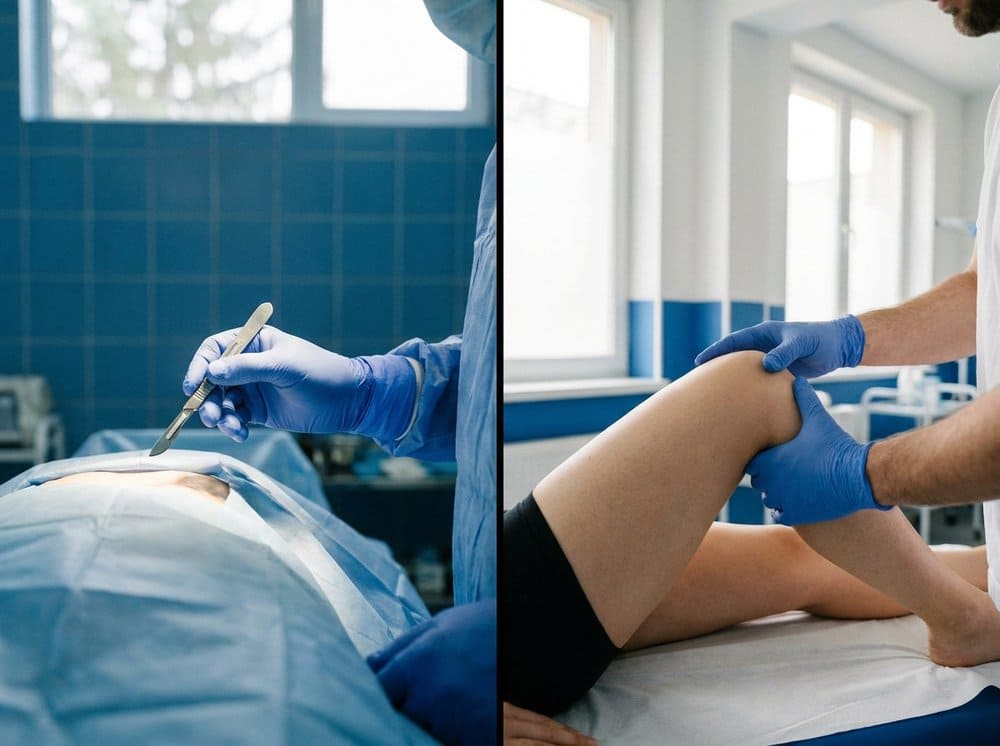
Doctors are trained to diagnose cause. Physical therapists are trained to restore function. Most everyday joint and soft-tissue pain in adults is a problem of function — weakness, stiffness, poor movement patterns, deconditioning — with no new, dangerous underlying cause. These problems respond to hands-on assessment, exercise prescription, and graded loading far better than they respond to a medication or a scan.
That is not a criticism of medicine. It is a statement about what chronic, non-red-flag musculoskeletal pain actually is. In most developed health systems, physical therapists are now the first point of contact for uncomplicated MSK pain, and the evidence — across low back pain, neck pain, knee OA, rotator cuff tendinopathy, and plantar fasciitis — consistently supports that pathway.
See a PT first when
The following patterns are almost always best handled by a physical therapist as the primary provider:
- Gradual-onset joint or muscle pain that has been around for days or weeks without an acute injury — a stiff neck after a long travel week, a shoulder that flares up when you sleep on it, a low back that started aching after a desk-bound stretch
- Chronic mechanical pain that you know well — it comes and goes, responds to movement, worsens with specific postures, and has no new feature
- Post-surgical rehabilitation once you have been cleared by your surgeon — our physical rehabilitation service takes over from this point
- Recurrent injuries in runners, cyclists, or gym-goers that seem to return every few months
- Balance and falls in older adults, particularly with unsteady gait or fear of falling
- Mild to moderate osteoarthritis — for which exercise therapy has stronger evidence than any medication short of total joint replacement. See the injection comparison piece for how PT fits alongside non-surgical options
In PH, physical therapists registered with the PRC (PTRP) can assess and treat without a doctor's referral in most clinical contexts. An HMO-reimbursable visit typically does require a referral letter — that is an administrative rule, not a clinical one.
See a doctor first when
Some patterns genuinely need a medical evaluation before physiotherapy. These are the classical "red flags" in MSK medicine, and a good PT will recognise them and refer back to a doctor anyway — but you save time by starting on the right side of the door.
- Severe trauma — a fall, a motor vehicle accident, a crush, a sporting injury with immediate deformity or inability to bear weight
- Pain at rest or at night that is not relieved by position changes — particularly in the spine, this can suggest infection, fracture, or malignancy
- Systemic features — fever, unexplained weight loss, night sweats, general malaise accompanying the pain
- Neurological features — progressive weakness, numbness in a dermatomal pattern, loss of bowel or bladder control (cauda equina — emergency), foot drop
- New imaging needed — if the clinical picture demands an MRI, a bone scan, or labs to rule out serious pathology, that is the doctor's job
- Pre-existing cancer, osteoporosis, long-term steroid use, or IV drug history with new bone pain — lower threshold for evaluation
- Children under 12 with joint pain — paediatric MSK has a different differential diagnosis and is better triaged by a doctor
"If the pain has a story you can explain and a pattern you recognise, it is usually a PT question. If the pain is strange, systemic, or scary, it is a doctor question. Most pain is the first kind."
When both make sense
Many patients benefit from parallel care. A patient with knee osteoarthritis might see an orthopedic doctor for diagnostic certainty and periodic image-guided injections, and a physical therapist for exercise prescription and adherence. Post-surgical patients see their surgeon for wound checks and imaging, and a PT for daily rehab work — the roles are complementary. Our post-surgery rehab program is designed to sit inside that collaboration.
At Myntrava both roles sit under one roof. A patient walking in with a 6-month history of knee pain will typically see an orthopedic surgeon for the first visit — to read the X-ray, to exclude a red flag, and to outline realistic options — and then transition to a PTRP for the actual rehabilitation work. That handoff is where the multi-modal pain management article becomes most relevant, because the transition from "medical problem" to "rehabilitation problem" is where many patients get stuck on medication longer than they need to.
The PH context
Physical therapy is widely available in Metro Manila but unevenly accessed. Many patients bounce through three doctors, a round of imaging, and several prescriptions before anyone mentions PT. The HMO system contributes to this — consultations are typically easier to schedule and reimburse than PT courses, even when PT would be the higher-value intervention. If your HMO requires a doctor's referral for PT, ask for one at your first orthopedic visit rather than waiting three months. Most PRC-licensed PTRPs accept direct referrals on standard HMO letterhead.
Quick self-triage
Before you book, ask yourself three questions:
- Do I have any of the red flag features above? If yes, doctor first.
- Is the pain mechanical — it has a story, responds to movement, has a pattern? If yes, PT is usually a good first stop.
- Has it been going on for more than 6 weeks with no progress? If yes, an orthopedic evaluation is worth adding even if the pain is clearly mechanical, because chronicity shifts the differential slightly.
This is not a substitute for examination, but it will usually route you to the right first appointment and save you time and money. And if you get it wrong, a good PT or doctor will redirect you — neither profession loses anything by helping you find the right room.
The honest summary
Most joint and muscle pain is a functional problem, and most functional problems get better faster in the hands of a physical therapist than in the hands of a doctor. Doctors are essential when the story is strange, the features are systemic, or the anatomy needs imaging. In between those two poles — which is where most pain lives — the PT is usually the better first phone call.