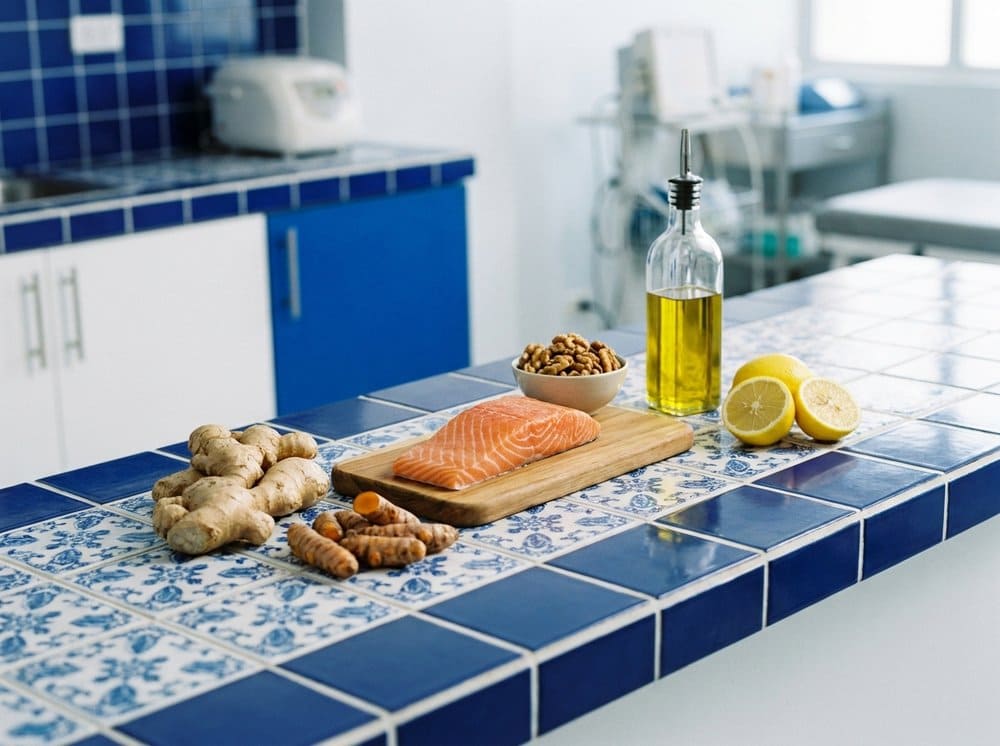
When a patient asks us what to eat for their knees, the honest first answer is that food does not replace treatment for structural disease. A Grade III knee does not become a Grade I knee because you drank turmeric tea. What food can do — and does, repeatedly, in well-designed clinical trials — is lower the background level of low-grade systemic inflammation that amplifies joint pain. A Mediterranean-style diet has been shown to reduce symptoms in rheumatoid arthritis and to modestly improve pain and function in osteoarthritis, and the Arthritis Foundation has formally endorsed it for that reason.
The following five foods carry the heaviest evidence. They are all available in Manila — in Landmark, S&R, Rustan's, and most wet markets — though a few need to be bought with a little more attention than the rest.
1. Fatty fish (omega-3 fatty acids)
Salmon, sardines, mackerel, and anchovies contain high concentrations of the long-chain omega-3 fatty acids EPA and DHA. These are incorporated into cell membranes and, once there, compete with arachidonic acid in the production of inflammatory prostaglandins — producing the less-inflammatory series instead. The practical upshot is a measurable reduction in morning stiffness and tender joint count, most clearly demonstrated in rheumatoid arthritis trials but increasingly in OA as well.
Dose that has shown benefit in trials: roughly 2–3 g of combined EPA+DHA per day, which translates to two servings of fatty fish per week or about a gram of concentrated fish oil supplement daily. In Manila, frozen Norwegian salmon and Spanish mackerel are widely available; canned sardines in olive oil (not in tomato sauce or with chili) are an excellent cheap alternative and one we often recommend for patients on tighter budgets. This feeds directly into what happens during monsoon-season joint flares, when the baseline inflammatory state matters more than usual.
2. Extra-virgin olive oil (oleocanthal)
Extra-virgin olive oil contains oleocanthal, a compound that inhibits the same COX-1 and COX-2 enzymes that ibuprofen inhibits — not as powerfully, but via the same pathway. A 2005 paper in Nature first described this "ibuprofen-like" activity, and subsequent clinical work has shown that populations with high habitual olive-oil intake have lower rates of inflammatory disease.
Practical note: it must be extra-virgin and cold-pressed. The refining process used to produce regular olive oil destroys most of the oleocanthal. Shop by harvest date rather than by brand — a bottle pressed more than 18 months ago has lost most of its active compounds. Two tablespoons a day, drizzled on salads and steamed vegetables (not fried, because high heat degrades the phenolics), is a reasonable target.
3. Berries (anthocyanins)
Blueberries, strawberries, and pomegranates are dense in anthocyanins, the pigment compounds responsible for their deep red-purple colour. Anthocyanins reduce circulating levels of C-reactive protein and IL-6, two of the inflammatory markers most consistently elevated in symptomatic OA.
A cup a day, fresh or frozen, is the dose used in most of the clinical literature. Fresh imported berries are expensive in Manila — around ₱400–600 for 250g in S&R or Landmark — but frozen berries are a fraction of the price, nutritionally equivalent (sometimes superior because they are frozen at peak ripeness), and fine for blending into a morning smoothie. Local strawberries from Benguet during cool-season harvest are another option. If you are newly diagnosed with knee OA, this is the easiest food to add — see also our summary of what your X-ray grade actually means for context on where food fits in a broader plan.
4. Dark leafy greens (vitamin K, polyphenols)
Kale, spinach, bok choy, kangkong, pechay, and alugbati all carry meaningful amounts of vitamin K1, along with magnesium, folate, and a range of polyphenols. Vitamin K is necessary for the carboxylation of matrix Gla protein — a protein expressed in articular cartilage that helps regulate calcification. Low dietary vitamin K is associated with a higher prevalence of radiographic hand and knee OA in the Framingham cohort.
Two cups of raw greens or one cup of cooked greens per day is the target. Kangkong and pechay from any wet market are fine; frozen chopped spinach from the supermarket is equally effective and far more convenient for weeknight cooking. A note for patients on warfarin — consistency matters more than quantity. Do not swing wildly between zero and ten servings; pick a level and stay near it.
5. Turmeric (curcumin)
The active compound in turmeric is curcumin, a polyphenol with NF-κB inhibitory activity. Several randomised controlled trials have shown curcumin to reduce knee OA pain to a degree comparable to low-dose ibuprofen, with far fewer gastrointestinal side effects. The 2019 meta-analysis in the Journal of Medicinal Food pooling 1,600+ patients found meaningful effects on WOMAC pain and function scores.
Caveat: raw turmeric in curry has poor bioavailability. The clinically effective dose is typically 500 mg of standardised curcumin extract twice daily, taken with black pepper (piperine) and a fatty meal, both of which dramatically improve absorption. Discuss with your physician before starting if you are on anticoagulants, because curcumin has a mild antiplatelet effect.
"A diet rich in whole grains, fruits, vegetables, fish, and olive oil is associated with lower levels of inflammation and improved pain and physical function in people with osteoarthritis."
— Arthritis Foundation, Dietary Guidance Position Statement
What does not work (no matter what the packaging claims)
- Oral collagen supplements. The evidence for collagen peptides in OA is weak and inconsistent. Collagen is broken down into amino acids in the stomach; it does not travel, intact, to your knee. Save your ₱2,000 a month.
- "Detox" teas and cleanses. The liver and kidneys do not require help from tea. Most detox products are mild laxatives and diuretics that cause short-term weight loss through fluid loss, not inflammation reduction.
- Glucosamine/chondroitin alone. Large trials (GAIT, LEGS) have shown no consistent benefit over placebo for most patients, though a small subgroup with moderate-to-severe pain may get modest relief. It is not harmful — just usually not worth the monthly cost.
- Apple cider vinegar shots. No credible evidence for joint benefits, and a real risk of tooth enamel erosion and gastritis.
Where food fits
Diet is a long-horizon tool. You will not feel dramatically different a week after you switch to Mediterranean eating — but at the three-month mark, most patients who commit to it report less morning stiffness, more good days than bad, and often a few kilograms lost. That weight loss alone — at roughly a 4:1 mechanical advantage through the knee — is often the single largest contributor. Patients enrolled in our 12-session osteoarthritis program receive individualised dietary guidance as part of the assessment, and for patients with concurrent rehab needs our physiotherapy nutrition notes are a useful companion resource. Pair food changes with movement, not with miracle claims.