Day 1: The knee is not yours yet
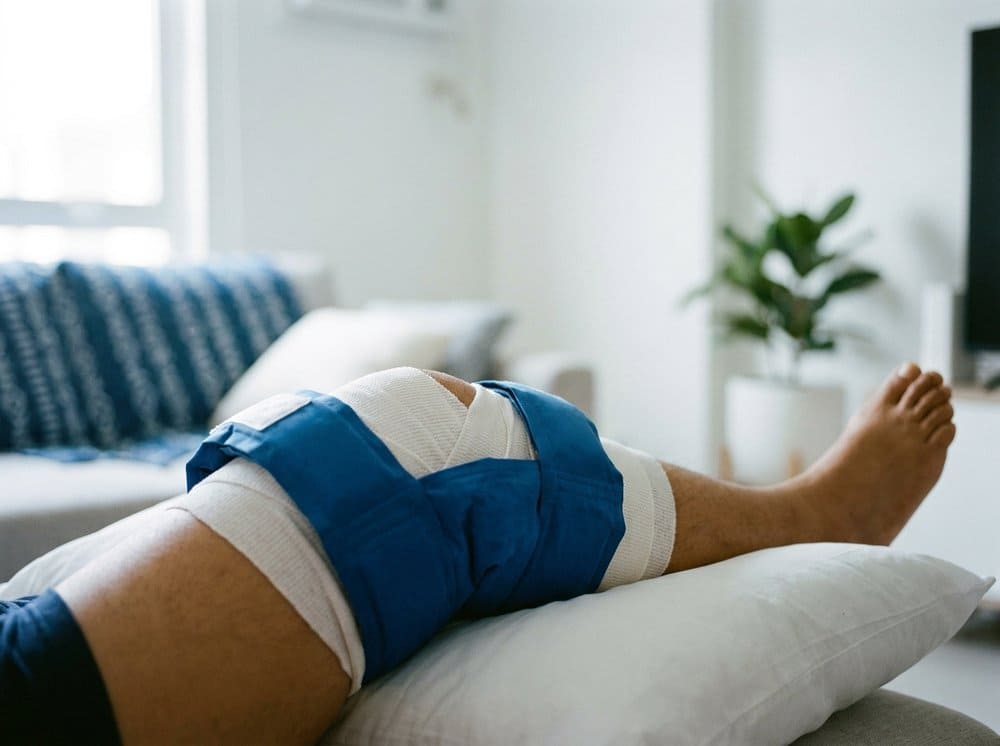
You wake up from spinal or general anaesthesia in the orthopedic ward. The knee is heavily bandaged, often with a compression wrap, and drains may still be in place. A continuous cold-therapy cuff or simple ice pack is applied over the dressing for 20 minutes every two hours. Elevation — heel on a pillow, not the knee itself — is more important than patients expect, because gravity is doing most of the work keeping post-operative swelling from pooling in the calf.
Within six hours of surgery, we ask you to start quadriceps sets: tighten the thigh muscle, push the back of the knee down into the bed, hold for five seconds, release. Ten repetitions every waking hour. It feels like nothing is happening. Something is — the quad is the single most important muscle for knee recovery, and it begins to shut down within 24 hours of disuse.
Pain on day one is typically managed with a multi-modal cocktail: a scheduled paracetamol, a short course of a weak opioid (tramadol is standard at most Makati Med and St Luke's protocols), an NSAID if renal function allows, and a periarticular injection placed by your surgeon during closure. You will rate it 4–6 on the VAS scale. That is normal. Pain management without over-relying on medication becomes the theme of the next six weeks.
Day 2–3: First steps
A continuous passive motion (CPM) machine may be fitted to your leg if your surgeon favours it — evidence for CPM is mixed, but most Philippine protocols still use it for 2–4 hours daily in the first 72 hours to prevent stiffness. You will also start ankle pumps (flexing the foot up and down to prevent deep vein thrombosis) and heel slides (sliding the heel toward the buttock along the bed, bending the knee as far as tolerable).
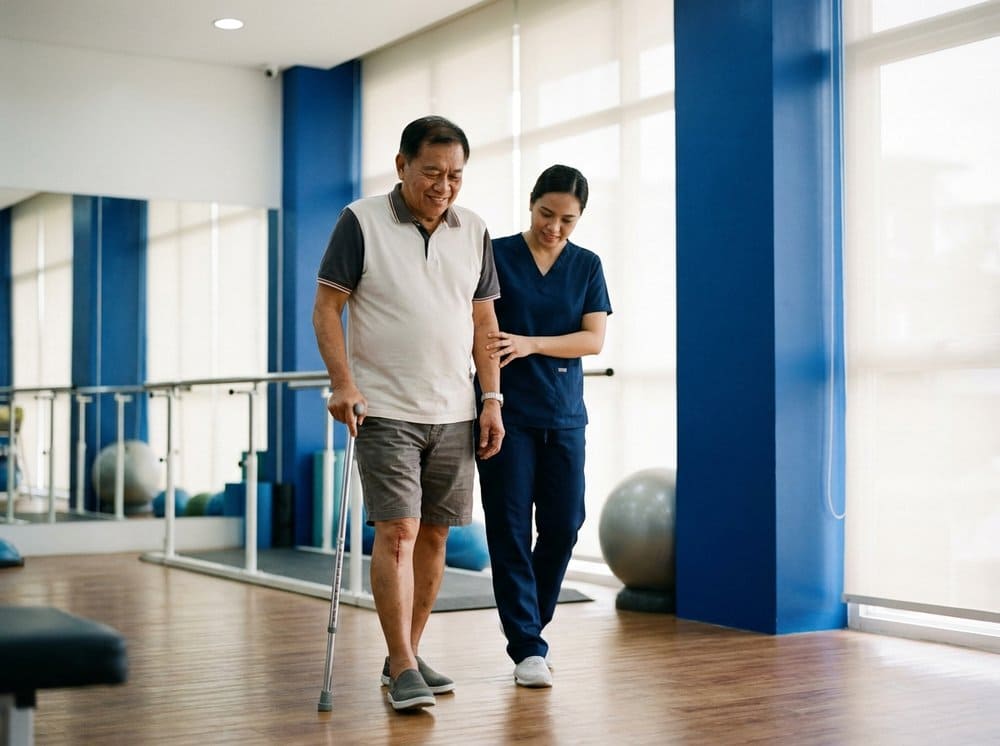
On day two, physiotherapy formally begins. A PTRP will get you sitting on the edge of the bed with your legs hanging down — a surprisingly challenging first milestone. By the end of day two or early day three, most patients take their first assisted steps to the bedside toilet using a standard walker. Weight-bearing as tolerated is the protocol for cemented knees, which is what almost all PH surgeons use.
"The goal in the first 72 hours is not distance. It is 90 degrees of flexion and a straight leg raise. Everything else follows from those two numbers."
Day 4–5: Walker-assisted walking begins
By the fourth day, most patients are discharged from hospital — earlier if their home setup is accessible, later if they live in a condo with stairs and no elevator. Before discharge we check three things: you can transfer from bed to chair unassisted, you can walk 10 meters with a walker, and you can climb three steps with a single rail. If any of these fail, the stay is extended by a day.
The knee at this point is still swollen to roughly 1.5 times its normal size. Bruising typically starts tracking down the shin on day four or five — this is gravity moving old blood, not a new injury. It can look alarming. It is not. Swelling peaks between day three and day five and then slowly declines over the following six weeks. Ice, elevation, and ankle pumps remain the mainstays.
Day 6–7: Home routine takes shape
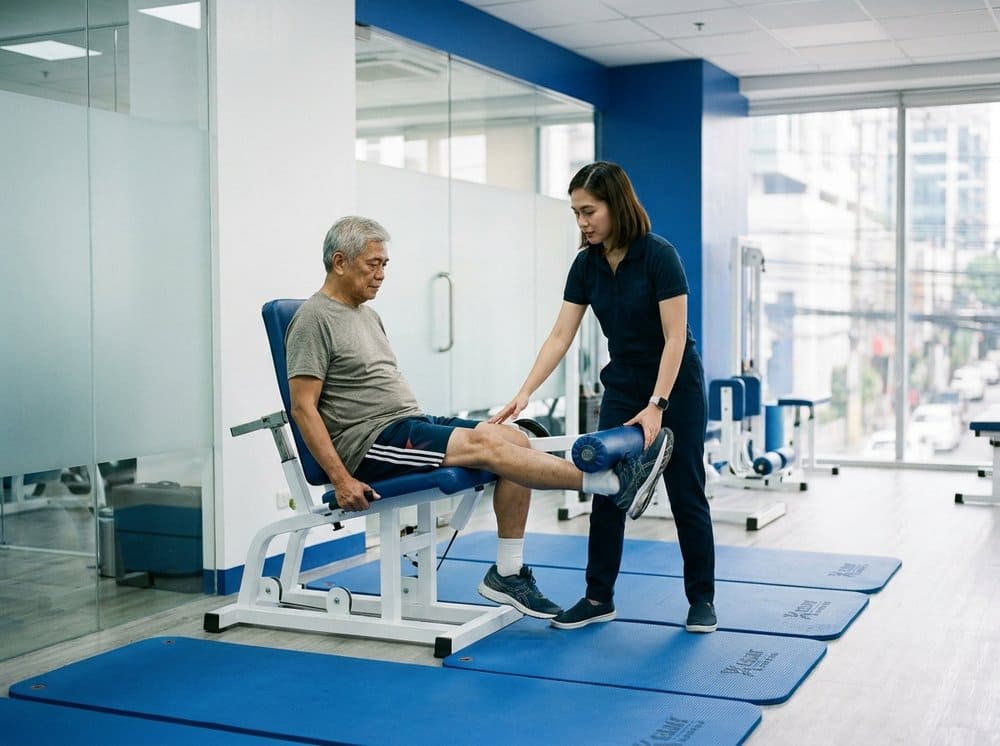
By the end of the first week, outpatient physiotherapy usually begins — either at our Makati clinic, at a facility closer to home, or via home visits if mobility is limited. Sessions run 45 minutes, three times a week, for the first 6–8 weeks. The early goals are simple and measurable: 90° of knee flexion by week two, 110° by week six, full straight-leg raise against gravity, and 100 meters of walker-assisted walking.
If you are curious about what the longer arc looks like, our ACL reconstruction 26-week roadmap uses the same four-phase structure most orthopedic rehabilitation follows. Our full post-surgery rehab program runs 16 sessions and covers weeks one through sixteen. For those asking whether they should have considered non-surgical options first, the comparison of PRP, HA, and steroid injections is a reasonable starting point — though for Kellgren-Lawrence Grade IV knees, replacement remains the only durable answer.
What is normal vs what to flag
Expected: swelling, bruising, warmth around the incision, difficulty sleeping on the operated side, a feeling that the knee is "not yours," night-time aching that wakes you at 3 AM, poor appetite, constipation from opioid use.
Flag immediately: calf pain and swelling without knee swelling (possible DVT), fever above 38.5°C, purulent discharge or a red streak tracking from the incision, sudden severe pain unrelieved by medication, chest pain or breathlessness.
The Makati commute matters too — if you live in Quezon City or Alabang and your surgeon is in Ayala, plan for a driver or a booked Grab every physiotherapy session for at least the first four weeks. Jeepney steps are not compatible with an early-TKR knee. Monsoon season adds another complication: the barometric changes can worsen joint aches for weeks, and a wet tile floor is a serious fall risk. Plan accordingly.
The honest truth
Most patients ask us, in week one, whether the surgery was worth it. The answer at day seven is almost always "I don't know yet." That is the correct answer. TKR is not a one-week procedure. It is a 12-week project with a 12-month tail, and the first week is simply laying the groundwork — a straight quad, 90 degrees of bend, and a walker you can trust.
By week six you will know. By week twelve most patients are walking unassisted around Greenbelt. By one year, the vast majority report their only regret is not having done it sooner.