Why hip recovery differs from knee recovery
Patients often read about what the first week after knee replacement looks like and assume hip replacement follows the same pattern. It does not. The hip is deeper, better vascularised, covered by more muscle, and — critically — it does not flex into a functional arc the way a knee does. Most THA patients leave the hospital with less pain than TKR patients, walk further by day three, and report a more linear recovery curve. The trade-off is a set of hip precautions — positional restrictions designed to prevent dislocation while the soft tissues heal.
The two main approaches
Most PH surgeons use either a posterior approach (entering through the back of the hip) or a direct anterior approach (through the front, between muscle planes). The posterior approach is faster, allows better exposure, but requires stricter precautions for the first 6–12 weeks because the posterior capsule and short external rotators are temporarily weak. The anterior approach has looser precautions and often walks faster, but has a steeper surgeon learning curve and a slightly higher risk of early fracture or nerve irritation.
Precautions vary by approach. For posterior-approach THA, the standard restrictions for 6–12 weeks are:
- No hip flexion beyond 90° — no deep chairs, no leaning forward to tie shoes, no squatting
- No internal rotation — no crossing the operated leg toward the other
- No adduction past neutral — keep a pillow between the knees when sleeping
These restrictions are not academic. Dislocation in the first 12 weeks is a real event, and it almost always happens during a forgotten precaution — pulling on a sock, leaning forward in a low jeepney seat, reaching for something on the floor.
Week 1–2: Walker-assisted walking
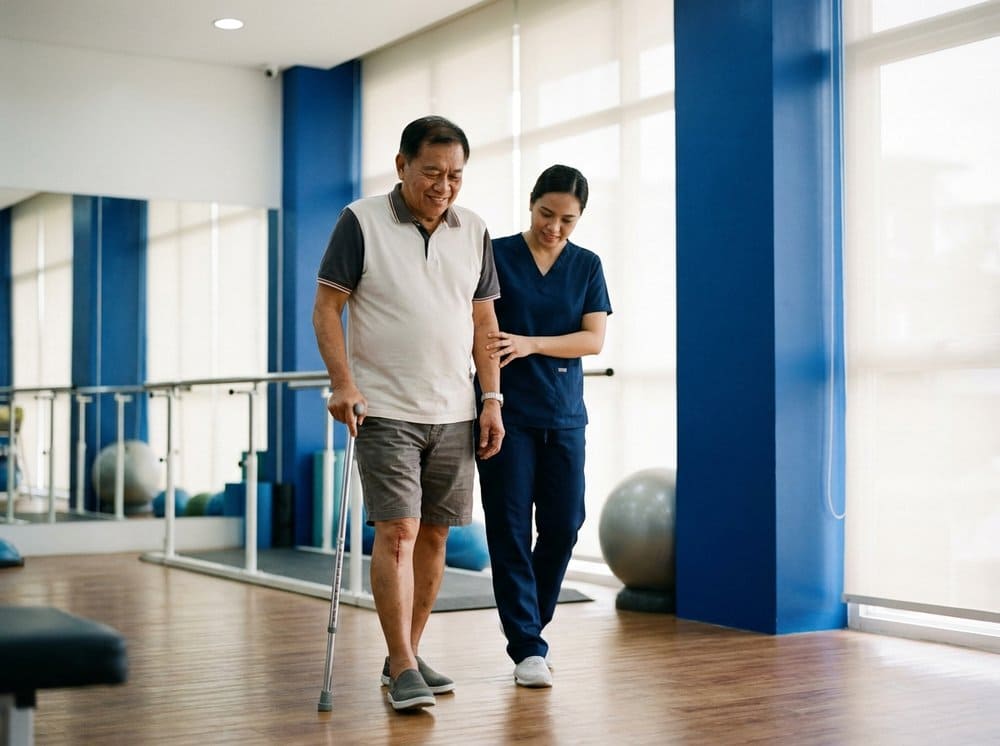
Within 6–12 hours of surgery, a PT has the patient sitting on the edge of the bed. By the end of day one most patients take their first walker-assisted steps to the bathroom. Weight-bearing as tolerated is the norm for cemented or uncemented press-fit implants — the vast majority of THA done in PH. True non-weight-bearing is rare outside of revision surgery or fracture cases.
Daily targets in week 1–2:
- Walker walks, gradually extending from 5 m to 50–100 m in short bursts
- Ankle pumps every waking hour (DVT prevention)
- Isometric quad sets and gluteal squeezes
- Supine heel slides within precautions (no flexion beyond 90°)
- Transfers bed-to-chair with precautions observed — bed and chair need to be at the right height
Home setup matters enormously. A raised toilet seat, a firm-high chair, a walker with wheels (rollator), and a bed at knee-height minimum are standard. Condo patients in Makati need to confirm elevator access — stairs are possible but slow and should be practiced with PT before discharge.
Week 3–4: Cane transition
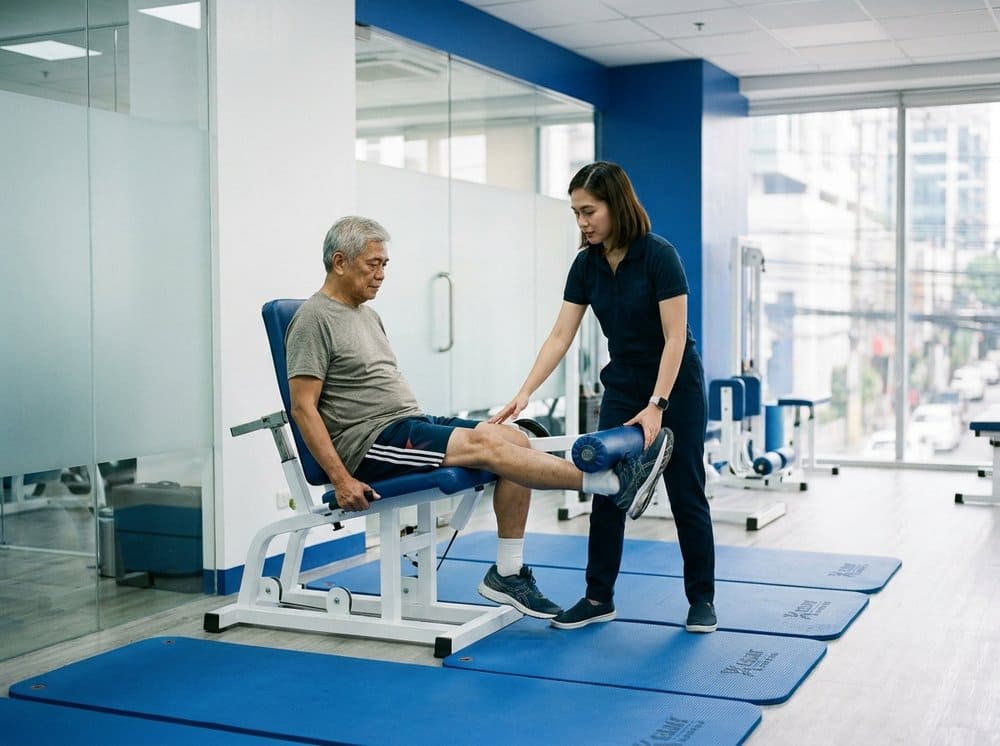
By week three most patients have graduated to a single cane, held in the opposite hand to the operated hip. The biomechanics are deliberate: a cane in the contralateral hand reduces the load on the operated hip by roughly 25% without disrupting normal gait mechanics. Outpatient physiotherapy — sessions at our physical rehabilitation service three times a week — focuses on:
- Gait training with cane, attention to step length symmetry and heel-strike
- Standing hip abductor strengthening (critical for Trendelenburg prevention)
- Progressive stationary cycling with seat elevated to respect flexion limits
- Balance work — tandem stance, single-leg stance on the non-operated side first
"Patients ask when they can throw the cane. The answer is when they can walk across the clinic without a visible limp. Sometimes that is week four. Sometimes week eight."
Week 5–6: Full weight-bearing, stride retraining
By weeks five and six, most patients are walking without an assistive device at home and using a cane only for long distances outdoors. This is when gait retraining becomes subtle and important. The operated leg has been offloaded for weeks and the brain has learned compensations — a short stance phase on the operated side, trunk lean, hip hike. These compensations are baked in quickly and are surprisingly hard to undo later.
Stride retraining drills we use:
- Treadmill walking at slow speed with mirror feedback
- Step-ups with controlled eccentric lowering (small step height first)
- Sidewalk walks with marked stride length targets
- Clamshells and side-lying abduction for gluteus medius reactivation
Pain in this phase should be minimal. If it is not, a conversation about multi-modal pain management is more appropriate than a new prescription. Occasional lateral hip pain at 4–6 weeks often reflects abductor fatigue rather than implant trouble.
Month 2–3: Full function
By the start of month three most patients are walking unassisted over any reasonable distance, climbing stairs one foot over the other, and returning to light recreational walking (around the neighbourhood, around a mall). Driving typically resumes at 4–6 weeks for left-hip patients and 6–8 weeks for right-hip patients, once hip flexion comfortably clears car entry and exit and emergency braking is safe.
Hip precautions are relaxed progressively from week 6–12 depending on surgeon and approach. Return to recreational sport (brisk walking, cycling, swimming, doubles tennis, golf) is typically permitted at 3 months. High-impact activity — running, jumping, singles tennis, basketball — is generally discouraged lifelong for cemented implants to preserve bearing life, though individual patients and newer bearing surfaces can change that conversation. Our post-surgery rehab program plans the full 16-session arc with that return-to-life goal in mind.
The Makati context
Most THA patients at our clinic live in Makati, Taguig, Pasig, or southern Metro Manila and commute back to physiotherapy via Grab for the first 8 weeks. Jeepneys are contraindicated until hip flexion safely clears the entry arc — usually week 8–10. Stairs without a rail are avoided for the first 12 weeks. Monsoon season and wet tile floors deserve genuine respect; a fall onto a new hip implant can require revision.
HMO coverage for THA is generally strong across Maxicare, Medicard, Intellicare, and PhilHealth catastrophic coverage. Expect 2–3 days of inpatient stay, 12–16 PT sessions, and a final surgical follow-up at 3 months. For patients with related knee OA, our daily movement program for arthritic knees complements hip rehab well.
The honest summary
Hip replacement is, for most patients, one of the most gratifying operations in medicine. The pain that ruled their life for years is gone within days. The phased return to walking is deliberate — walker, then cane, then independent — and each step is a negotiation between tissue healing and reclaiming mobility. Patients who respect the precautions and do the physiotherapy almost uniformly return to a better quality of life than they remember having before the hip ever started hurting.